

Average Pool Deck Size for Rhode Island Backyards: A 2026 Planning Guide
Most Rhode Island homeowners build pool decks between 600 and 1,200 square feet, with the right size depending on pool dimensions, lot size, and how the family plans to use the space.
Smaller city lots in Providence or Cranston often support 500 to 800 square feet, while larger suburban properties in North Kingstown or South Kingstown can accommodate decks of 1,000 to 1,500 square feet.
Planning a pool deck in Rhode Island comes with a few extra wrinkles compared to other parts of the country. Lot sizes vary widely from the dense neighborhoods of Providence to the open acreage found in towns like Burrillville or Glocester.
Local zoning rules differ from one municipality to the next, and the state's wet winters and coastal humidity put real demands on whatever material you choose. Getting the pool deck size right from the start helps you avoid a cramped space that feels unsafe, or an oversized slab that costs more than it adds in value.
This guide walks through typical pool deck sizes by pool type, how Rhode Island lot patterns affect your options, local setback rules to check before you build, and what homeowners across the state are actually installing in 2026.
Why Pool Deck Size Matters for Rhode Island Homeowners
A pool deck does more than provide a walking surface around the water. It functions as an outdoor living space where people dry off, set up chairs, and gather in the evening. When the size is wrong in either direction, the whole yard feels off.
A deck that's too small leaves little room for furniture and creates crowding near the pool edge, which can become a safety concern. A deck that's too large adds cost without adding usable space, and it can make a residential backyard feel more like a commercial facility than a home retreat.
The right size depends on three factors: the pool's dimensions, the shape and size of the lot, and how the household intends to use the space day to day.
Typical Pool Deck Sizes by Pool Type
A useful starting point is to size the deck relative to the pool itself. Most contractors in Rhode Island recommend a deck area that is at least equal to the pool's surface area, and ideally 1.5 to 2 times that size.
- Small inground pool (12x24 ft / 288 sq ft): Deck sizes typically range from 500 to 700 square feet
- Medium inground pool (16x32 ft / 512 sq ft): Deck sizes typically range from 700 to 1,000 square feet
- Large inground pool (20x40 ft / 800 sq ft): Deck sizes typically range from 1,000 to 1,400 square feet
- Above-ground pool with attached deck: Deck sizes typically range from 200 to 500 square feet, depending on whether the deck wraps the pool or extends outward
- Freeform or custom pools: Sizing is more variable but generally follows the same 1.5x to 2x guideline
These ranges reflect what Rhode Island homeowners commonly plan for when they want a functional pool area without over-building the yard.
How Rhode Island Lot Sizes Shape Deck Planning
Rhode Island is the smallest state in the country, and that affects backyard planning more than many homeowners expect. Median lot sizes in cities like Providence, Pawtucket, and Central Falls tend to run smaller than the national average, with many backyards measuring roughly 40 to 60 feet deep and 30 to 50 feet wide. That limits how large a pool deck can go before running into setback requirements.
Suburban and rural towns offer more flexibility. Properties in Burrillville, Glocester, Scituate, and Foster often sit on half an acre or more, giving homeowners room for larger decks with separate zones for dining, lounging, and entertaining.
Coastal communities such as Newport, Middletown, and Narragansett present a different set of considerations. Lots here can be narrow and irregularly shaped, and proximity to the water may trigger additional permitting through state coastal authorities. In these settings, thoughtful layout matters more than raw square footage.
For homeowners trying to make a compact lot work, this guide to backyard pool and patio ideas for small Rhode Island yards covers design approaches that help smaller spaces feel comfortable rather than crowded.
Zoning and Setback Rules to Check Before You Build
Local zoning plays a direct role in how large a pool deck can be. Rhode Island municipalities each set their own setback requirements for pools and attached structures.
- Providence: Pool structures typically require a minimum 5 to 10 foot setback from rear and side property lines
- Warwick: Setbacks generally run 5 feet from side lines and 10 feet from the rear line, though this varies by zone
- Cranston: Requires permits for both the pool and any attached deck, with setbacks similar to Warwick
- Newport: Historic districts and coastal overlay zones near the waterfront carry stricter review
- North Kingstown and South Kingstown: Larger average lot sizes tend to support more generous setback allowances
Permits are required for inground pools and most attached decks in every Rhode Island city and town. Confirming the rules with the local building department before finalizing a design avoids fines or the cost of removing a non-compliant structure later.
Materials That Hold Up in Rhode Island's Climate
Once a target square footage is set, material choice becomes the next decision. Rhode Island's freeze-thaw winters, humid summers, and coastal salt air all affect how a deck surface performs over time.
- Stamped concrete: A common, budget-friendly choice in Warwick, Cranston, and Johnston, with customizable texture and color
- Pavers (concrete or natural stone): Widely used in East Greenwich, Barrington, and Newport. Individual units can shift and be reset after freeze-thaw movement without replacing the whole surface
- Composite decking: Often used for above-ground pool decks and raised platforms, with low maintenance and resistance to rot
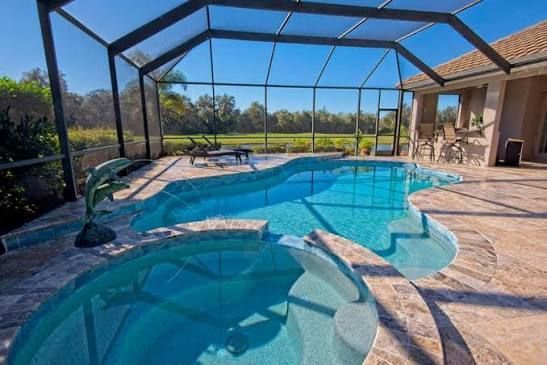
- Travertine or bluestone: Found in higher-end projects in Newport, Portsmouth, and South County, valued for staying cool underfoot
- Pressure-treated wood: A lower-cost option for above-ground pools, though it requires more upkeep in Rhode Island's climate than composite alternatives
For homeowners combining a pool deck with an adjoining patio area, this resource on integrating a patio with a pool in Rhode Island explains how to connect the two spaces with consistent materials and grading.
Organizing the Deck Into Functional Zones
Regardless of total square footage, how the space is divided affects how usable it feels. A well-planned Rhode Island pool deck typically includes:
- A wet zone directly around the pool for entry, exit, and swimming-related activity
- A lounge zone positioned to catch sun during the hours the family actually uses the pool
- A dining or entertaining area set slightly apart from the pool edge
- A transition zone connecting the deck to the house, which may include steps or a covered landing
Adding a dedicated dining area for six people, for example, generally adds 150 to 200 square feet beyond the baseline wet zone calculation.
What Does a Pool Deck Cost in Rhode Island?
Material and labor costs vary, but current general pricing for pool deck installation in Rhode Island runs as follows:
- Stamped concrete: $15 to $25 per square foot installed
- Pavers: $20 to $40 per square foot, depending on material and pattern complexity
- Natural stone (travertine, bluestone): $30 to $60 per square foot installed
- Composite decking: $25 to $45 per square foot, depending on brand and system
- Pressure-treated wood: $15 to $25 per square foot installed
A 900 square foot stamped concrete deck in Warwick or Cranston typically runs between $13,500 and $22,500 for installation alone, before fencing, lighting, or landscaping around the perimeter.
Pool Deck Sizes by Rhode Island Community
- Providence: Smaller lots call for tighter layouts. A 500 to 700 square foot deck around a compact pool is common, with vertical elements like privacy walls helping the space feel larger.
- Warwick: One of the more active markets for pool and deck installation, with average sizes running 800 to 1,100 square feet.
- Cranston: Similar lot patterns to Warwick, with multi-level decks sometimes used to separate the wet zone from an upper entertainment area.
- Newport: Compact coastal lots support decks around 600 to 900 square feet, often finished with travertine or natural stone to match the area's architectural character.
- North Kingstown and South Kingstown: Larger lots support decks of 1,000 to 1,500 square feet, frequently incorporating fire pits or additional seating areas.
- Westerly and South County: A popular area for vacation and second homes, with larger footprints and materials suited to coastal conditions.
Homeowners in towns such as Hopkinton working through site-specific layout questions can find more detail through this overview of paver patio and hardscaping work in Hopkinton, RI.
Steps for Planning the Right Pool Deck Size
- Measure the usable backyard area and confirm setback requirements with the local building department
- Choose a pool size and calculate 1.5 to 2 times that area as a starting deck target
- Add square footage for specific zones, such as dining or lounge areas
- Confirm permit requirements and any deed restrictions before finalizing the plan
- Get quotes from a few Rhode Island-based contractors before committing
Final Thoughts
The average pool deck size for Rhode Island backyards generally falls between 700 and 1,100 square feet for a single-family home, though the right number depends on lot size, local zoning, and how the space will actually be used.
Taking time during the planning phase, confirming local permitting requirements, and choosing materials suited to Rhode Island's climate all contribute to a pool deck that holds up and functions well for years to come.
Rhode Island Backyard Planner
Pool Deck Size Calculator
Estimate a practical deck area from your pool dimensions, compare it with typical Rhode Island layouts, and check whether the planned footprint fits your usable backyard.
Your planning results
Plan a functional wet zone around the pool, then leave enough room for circulation and the activities your household uses most.
Planning assumptions: For inground pools, the suggested area uses the article's general guideline of 1.5–2 times the pool surface area, with the entered activity space added on. The typical ranges are separate examples from the article and may not match the calculated target exactly.
Above-ground pools: The article gives a typical attached-deck range of 200–500 sq ft. The calculator uses that range as its base for this selection because deck layouts vary with wraparound design and the size of the access platform.
Before building: Verify setbacks, permits, easements, lot coverage, coastal review, and any stormwater requirements with the local building department. This calculator is for early planning and does not establish that a design complies with local rules.
Frequently Asked Questions
What is the average pool deck size in Rhode Island?
Most Rhode Island pool decks range from 600 to 1,200 square feet, with smaller city lots supporting 500 to 800 square feet and larger suburban lots supporting 1,000 to 1,500 square feet.
How much deck space do I need around a 16x32 pool?
A medium inground pool of this size typically pairs with a deck between 700 and 1,000 square feet, following the general guideline of 1.5 to 2 times the pool's surface area.
Do I need a permit for a pool deck in Rhode Island?
Yes. Every Rhode Island city and town requires permits for inground pools and most attached decks. Setback requirements vary by municipality, so checking with the local building department before finalizing a design is necessary.
What material holds up best to Rhode Island winters?
Pavers tend to perform well through freeze-thaw cycles because individual units can be reset without replacing the entire surface. Stamped concrete and natural stone are also common choices, depending on budget and location.
How close can a pool deck be to my property line in Rhode Island?
This varies by town. Providence, for example, generally requires a 5 to 10 foot setback, while Warwick and Cranston use similar ranges. Coastal towns like Newport may have additional review requirements near the waterfront.